
REFLECTIONS: Co-generative thoughts for future practice.
After finishing our argumentation labs, I released a survey to students with the goal of gathering their attitudes towards argumentation and science learning at SLA. This survey had three major sections and findings:
 Click above to view my students' thoughts on learning science at SLA! Click above to view my students' thoughts on learning science at SLA!
|
1. ATTITUDES ON SCIENCE: Students enjoy both informal and formal science education at SLA, but largely do not see themselves entering the STEM workforce.
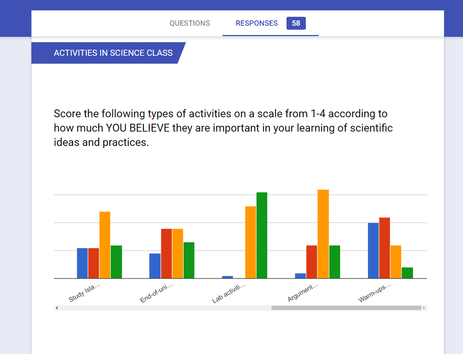
2. RANKING OF SCIENCE ACTIVITIES: Labs are overwhelmingly viewed as highly important learning activities among students. Argumentation activities and argumentation-driven inquiry, while less favored, are still viewed as important. 3. THOUGHTS ON ARGUMENTATION: Though fewer students have enjoyed learning argumentation than not, a large majority of students agree that it is an important practice in science class. They also report feeling stronger at the skill, but still not confident. |
I will elaborate on these findings below. For further exploration, Google Forms' Summary Response provides a comprehensive overview of students' responses, and further analyzed data is available in this accompanying spreadsheet as well.
|
|
Overall, students found learning argumentation to be a challenging experience. At the end of this study, they do not report feeling confident in their ability to construct scientific arguments. They also do not particularly indicate enjoying the practice of argumentation. However, they do report feeling that they have improved in this ability -- and, according to our averages, they have indeed improved. More practice and feedback would be necessary to continue building this skill, and perhaps with further mastery, so too would be there more enjoyment. The context in which students produce an argument may matter as well. In a comparison of ADI labs and previous argumentation activities, student viewed the labs as more important to their learning. This is in conjunction with a strong response towards other labs throughout the class: students perceive the highest importance in learning experiences which grant opportunities for autonomy and hands-on learning.
|
|
SELECTED RESPONSES
Challenges associated with argumentation:
Positive attitudes towards labs and ADI:
Negative attitudes towards epistemic commitments:
|
The relatively ill-structured nature of inquiry-based labs can be stressful for students, especially when viewed as an activity in which the goal is to prove a scientific concept or fact. This may be due to an unfamiliarity with the routines within ADI. Further practice may help students learn the goals and skills associated with argumentation, and then unlock emergent motivation as they gain competency (Csikszentmihalyi 1978).
Additionally, much of the concern of students here seems to be regarding wrongness in their data. In an educational setting where students are pressured to learn information rather than interpret it, this is a significant mental barrier to overcome. Discussions on growth mindset and the nature of science may be particularly useful here. Conversely, some students felt stronger having gone through these challenges. Speculatively, I would suspect that these students have built confidence around the conceptual and epistemic frameworks associated with science and argumentation (Sampson 2010). More assessment and measurements would be needed to verify this. Nonetheless, these responses are rewarding to see.
Troublingly, despite demonstrated gaps in their knowledge and inaccuracies in their arguments, many students approached this investigation with the assumption that there was no new information to be gained. They entered with a pre-existing set of beliefs and, never merging these beliefs with the newly presented information, rejected the new knowledge (Sewell 2002). In the future, I hope that this can be avoided by bringing these misconceptions to the surface early on. Identifying students' misconceptions, introducing discrepant phenomena, and then having students build arguments may be a key change in this learning progression.
Sampsom and Grooms (2009) propose a method based on exactly this, called the evaluate-alternatives instructional model. I hope to utilize this model in my future practice, in order to help students develop the skills and habits to critically evaluate scientific information throughout their lives. |
CONCLUDING REMARKS
I haven't been able to personally gauge the extent to which argumentation has helped my students, but I do see the beginnings of an upward trajectory. Sampson et al suggest that a "focus on the epistemic and social aspects of science," if sustained long enough, will lead to "a personal tipping point and... epistemic shift" in each student. In other words, continued practice of questioning and discussing ways of knowing should eventually lead to a paradigm shift in which students more readily utilize scientific frameworks when interpreting new information. In hopes of developing habits of critical analysis, I do plan to continue argumentation as a practice in my classroom. I also, however, plan to incorporate some additions in my curriculum regarding argumentation. I will make analysis and feedback of arguments more consistent and regularly occurring; I will add lessons around discrepant phenomena and evaluate-alternatives modeling; and I will incorporate more opportunities for socio-scientific decision making. Together, I hope that these features will allow students to gain both skills and confidence around the evaluation of all evidence, and therefore become empowered to take a critical stance towards the issues -- scientific or otherwise -- affecting our world.
I haven't been able to personally gauge the extent to which argumentation has helped my students, but I do see the beginnings of an upward trajectory. Sampson et al suggest that a "focus on the epistemic and social aspects of science," if sustained long enough, will lead to "a personal tipping point and... epistemic shift" in each student. In other words, continued practice of questioning and discussing ways of knowing should eventually lead to a paradigm shift in which students more readily utilize scientific frameworks when interpreting new information. In hopes of developing habits of critical analysis, I do plan to continue argumentation as a practice in my classroom. I also, however, plan to incorporate some additions in my curriculum regarding argumentation. I will make analysis and feedback of arguments more consistent and regularly occurring; I will add lessons around discrepant phenomena and evaluate-alternatives modeling; and I will incorporate more opportunities for socio-scientific decision making. Together, I hope that these features will allow students to gain both skills and confidence around the evaluation of all evidence, and therefore become empowered to take a critical stance towards the issues -- scientific or otherwise -- affecting our world.